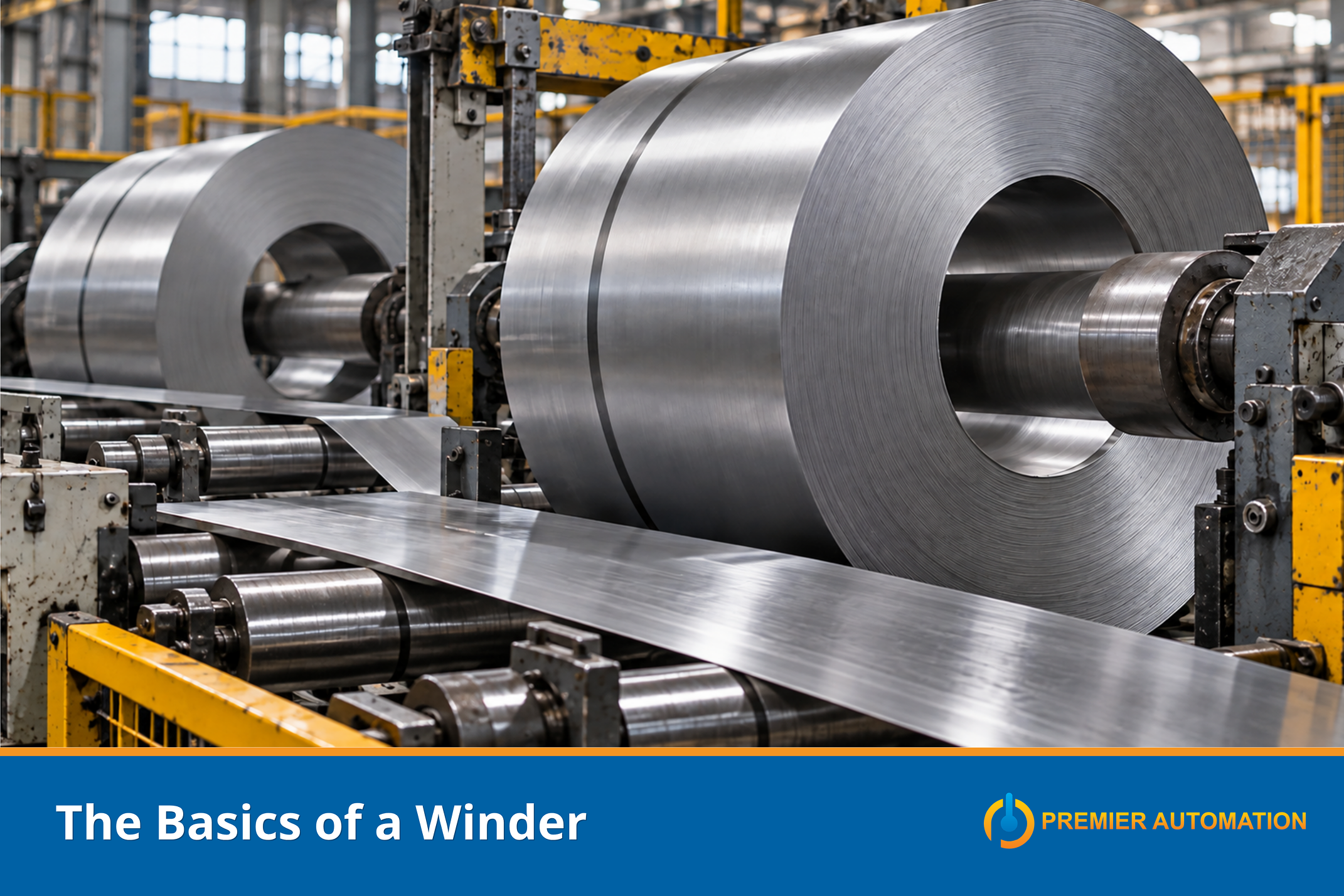
The Basics of a Winder
Winding material into a coil is a common automation application with a lot of technology at the core. Winders are used across many industries, and the material can range from heavy gauge steel and aluminum to thin plastic film, paper, and foil. Nearly any material that can be coiled for more economical transport and delivery is wound on a winder. In general, the lower the cost of the material, the faster the rates the manufacturers need to run to produce their product efficiently. Some of these products can be run at many thousands of feet per minute.
Winder Terms
Mandrel: The mandrel is what the material is wound up on. Some mandrels go with the material like the cardboard in a roll of paper towels and some stay with the machine. In some cases, such as steel rolling, the coil is taken from the machine without a mandrel.
PLI (Pounds per Linear Inch): This is a common unit used in winding applications. It is how many pounds of tension pull on each linear inch of width of the material. For example, if you are winding paper 20 inches wide at 5 PLI, you are asking for 100 pounds of tension.
Strip Break: This is when the material that is being wound breaks. This is normally a reason to stop the system as fast as possible.
What technology is behind a winding application?
There are many facets to the winding process. Some winding applications are very fast and complex and others are slow and simple, but most use some of the following technology.
Diameter Detection
In order to apply the correct amount of tension to the "web" of material that is being wound, an accurate diameter must be determined. The diameter can be determined many ways. A common method is by calculating the current diameter based on a ratio between the system line speed, as determined by an encoder or a pinch roll of some type, and the number of RPM that the winder is turning. For example, if a line is moving 60 feet per minute and the winder is turning 4 revolutions per minute, then the coil on the winder must have a circumference of 15 feet. The diameter is then calculated based on the circumference. Another option for diameter detection is a sonic or laser type sensor placed facing the coil. These need to be very stable and calibrated periodically to ensure accuracy. Another method is using a "Riding Roll" on top of the coil. This roll rides on top of the coil and raises due to the coil growing underneath it. A transducer of some sort is attached to this roll and a diameter can be obtained by reading the height of the roll.
Tension Control
The tension can be controlled in many ways on a winding system. A common way is with a dancer roll. A roll with an air or hydraulic cylinder is regulated at a designated pressure in the opposite direction of the winder. The material is wrapped around this roll and then wrapped around the winder. The dancer roll is monitored by a position sensor like an encoder, potentiometer, or a transducer. The winder system reads the position and either speeds up or slows down to maintain a position that is defined somewhere in the middle of the dancer roll's range of motion. This method dynamically changes the winder's speed.
A second method is to use a load cell to determine the tension. The winder can read the tension as seen by the material and adjust its speed and torque appropriately.
A more advanced method is to use the drive's calculated torque value to regulate the tension on the material. This method is often preferred because it eliminates the maintenance of the additional sensors and actuators needed for other methods. This method works well when the motor is properly sized to the application so that the full resolution of the torque feedback and control can be used. Load cells and dancers remain the better choice in applications that need direct tension measurement or very tight tension accuracy, so the right approach depends on your process.
A winder involves more than a short article can cover, but other areas to consider include:
- Taper Tension: Changing tension through the process for a better shaped roll, helping to eliminate coning or telescoping
- Fixed and Variable Inertia Compensation: Compensating for the inertia of the rolled material during starts, stops and speed changes to prevent slack or overtightening of the web.
- Friction and Windage: Compensating for the friction and mechanical losses of the winding components of the machine
Conclusion
Every winding application is different, so when you create, tune, or modify yours, work with a partner who has the experience to choose the right technology without over-simplifying or over-complicating your process. Premier Automation's team of engineers and service personnel have worked with and designed hundreds of winding applications. Contact Premier Automation to talk through your winding application.